



Saraswati Puja, also known as Basant Panchami or Shree Panchami, heralds the arrival of the spring season. Dedicated to Goddess Saraswati, the deity of knowledge, language, music, and arts, this celebration holds a special place among Hindus. They worship her and seek her blessings on this auspicious day.
Although the fervour and devotion with which the festival is celebrated remain the same across the country, different states have different traditions passed down from the ancient generations.

Looking forward to welcoming this spring festival? Read on this Wego article to learn more about celebrating Saraswati Puja in 2025.
Table of Contents
Saraswati Puja 2025 date & time
Saraswati Puja, which is Basant Panchami, falls on Sunday, 2 February 2025.
It is celebrated on the fifth day of the bright half of the Hindu month of Magha, which usually falls in late January or February. It precedes spring by forty days, as it is believed that any season takes that long to come into full bloom.
The festival is widely celebrated by Hindus in India, Bangladesh, Nepal, and many parts of the world. In fact, it is also observed in some parts of Indonesia and Bali as Hari Raya Saraswati.
Notable traditional celebrations across the country
The highlight of the festival is the worship of Goddess Saraswati. People dress enthusiastically in vibrant shades of her favourite colour, yellow, and pray before her statues and idols in nearby temples.
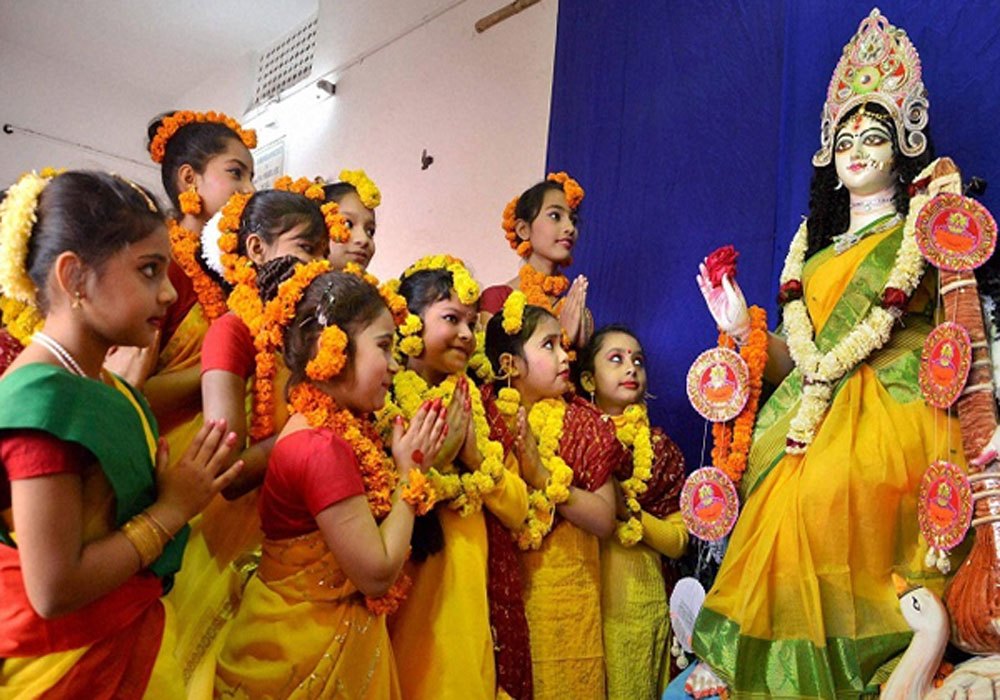
Image © Sandesh
In educational institutes as well, the goddess is worshipped with special prayers and pujas so as to seek her blessings for better knowledge and wisdom. Poetry and musical programs are also organized as a sign of reverence.
As the pandemic is still raging across India, some of the public aspects of the celebration may be more subdued. However, some states have eased restrictions following the Saraswati Puja celebrations.
Bengal and Bihar
Yellow-coloured sweets and rice dishes are prepared using saffron. Delicacies like boondi, ladoo, kheer, malpua, kesar halwa, kesari bhaat, sondesh and rajbhog are offered along with Ganga jal and mango wood.
Odisha
In Odisha, many schools and colleges have homas and yagnas for their students. Toddlers between the age of 2-5 years start formally learning on this auspicious day in the Khadi-Chuan or Vidya-Arambha, wherein they are introduced to the local music, dance, and language.
Maharashtra, Madhya Pradesh, Chhattisgarh and Uttar Pradesh
According to the legend believed in these states, this was the day when Madana, the Hindu god of love, shot arrows of flowers and bees at Lord Shiva to bring him back from his meditation and pay attention to his wife, Parvati.
That’s why, in these states, people also go to Shiva temples and worship the couple, offering mango flowers and ears of wheat. In Uttar Pradesh, Saraswati idols are immersed in River Ganga as part of the rituals.
Punjab
In this Northern state, the festival is celebrated by the Sikhs as Basant Panchami. Dressed in bright yellow clothes and turbans, they engage in spirited competitions of kite-flying, young and old alike. On this day, Sikhs also commemorate the martyrdom of Haqiqat Singh, who was arrested by Muslim ruler Zakariya Khan on false charges of insulting Islam.
Rajasthan
Here, it is customary for women and young girls to wear jasmine garlands.
Tamil Nadu, Andhra Pradesh, Telangana, Karnataka, and Kerala.
In the southern states of India, the festival is celebrated as Sri Panchami. It’s believed that Goddess Saraswati bestows wisdom, learning, and knowledge upon her devotees, as she’s considered an epitome of wisdom.
Students and teachers dress in new clothes, offering prayers to the goddess of knowledge, while various programs involving song and dance are organised to honour her. Toddlers begin their learning journey on this day in a unique ceremony known as Vidhyarambham.