

Ramadan, the ninth month of the Hijri calendar (a lunar calendar), is considered the holiest month in the Islamic faith. Through stringent fasting, discipline, introspection, and prayer, Muslims elevate their level of spiritual and physical submission to Allah, express their gratitude, and seek his forgiveness.
It is believed that during this month Allah revealed the holy Quran to Prophet Muhammad through the angel Gabriel. As a way of honoring this auspicious period, Muslims abstain from eating, drinking, smoking, any form of violence, anger, and also husband-wife intimacy from the breaking of dawn until the setting of the sun. Reading the Quran and making charitable donations (Zakat-al-Fitr) are also encouraged.

Table of Contents
Ramadan in Oman dates 2025
The beginning of Ramadan is subject to the sighting of the moon, and hence, there is some degree of uncertainty involved. However, it can be estimated by Muslim scholars and authorities by observing the appearance and cycle of the moon.
So far, Ramadan 2025 is expected to begin on 28 February 2025 and end on 30 or 31 March 2025, corresponding to Ramadan 1446 in the Islamic calendar.
Ramadan 2025 moon sighting in Oman
On the 29th day of Shaban, the moon sighting for Ramadan 2025 will take place. The moon sighting date for Ramadan 2025 varies in each country because the Shaban month does not begin on the same day in every country.
Ramadan celebration in Oman
In the days leading up to Ramadan, Omani households gear up zealously for the month-long festivities. It begins with purchasing all the supplies and ingredients required for traditional meals. Houses are dusted and mopped from roof to basement and made sparkling-clean, in line with the Quran’s stress on cleanliness and hygiene. Families and relatives get together for breaking their fasts, which is said to double the rewards of their self-restraint.
Omani women have a substantial role in the celebrations, from making a list of favourite food of all family members and preparing the fast-breaking tables accordingly, to educating the children about various religious traditions and customs.
Omanis also place importance on strengthening relations with other families in the society. Food and sweets are often exchanged with neighbours as a token of their affection, brotherhood and tolerance. In some areas the Qaranqasho is also celebrated, where children walk around their neighbourhoods collecting sweets, candies, nuts, and sometimes, money.
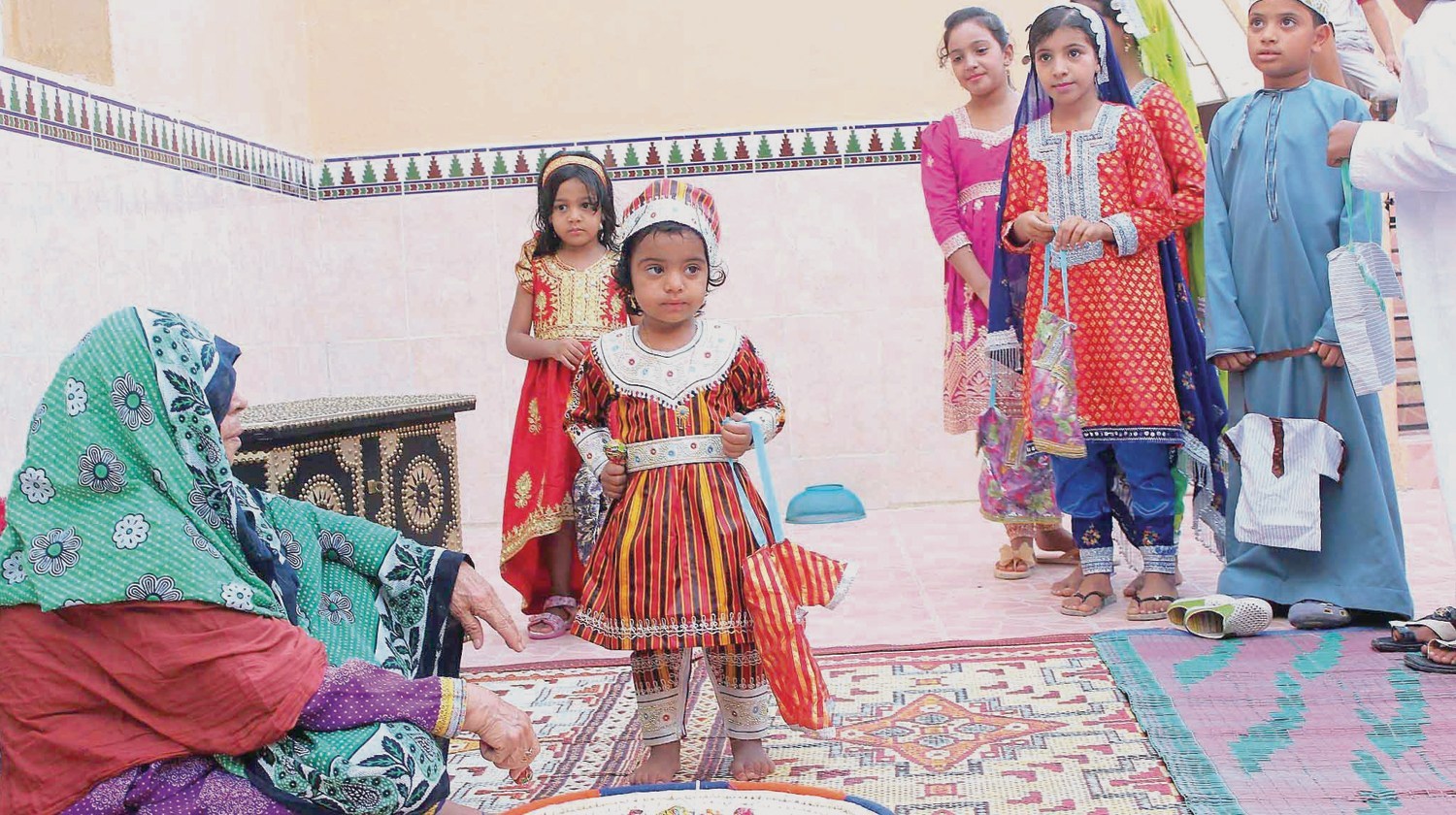
Image © Oman Observer
‘Al Habta’ is set up in the last days of the Holy Month of Ramadan. It’s an open market with a set and well-known day where all of the Eid Al Fitr necessities are shown. The ‘Habta’ is a long-standing tradition in Oman, and it is always bustling with visitors and residents.
Ramadan in Oman 2025 rules
Eating in public places, including workspaces and offices, is considered offensive and may get you in trouble with the police. If you aren’t fasting and want to eat or drink during daylight, you must do it indoors, out of sight of any Muslim. Loud and boisterous music is also prohibited in order to maintain proper decorum.
Dressing conservatively during the month is another custom you must be mindful of. Men and women should cover their shoulders and knees at all times. Tight and revealing clothes are a strict no-no, specifically so for women.
Ramadan praying hours in Oman
Muslims living in Muscat, Salalah, Seeb, Sohar, and other cities started observing Ramadan as per the Sehri time or Iftar time in Oman. This is one of the main reasons why the starting date of Ramadan in Oman has great significance for them. However, the Iftar and Sehri timings for Ramadan 2025 have not yet been predicted.
Please note that we’ll update this article once we receive appropriate information.