
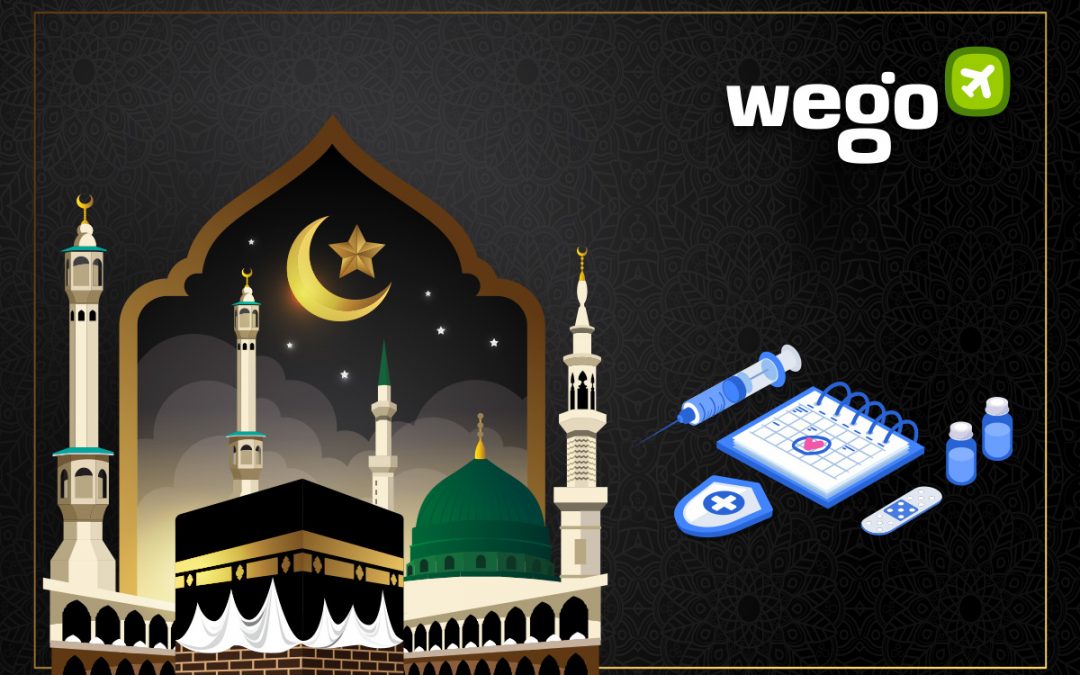
Before you book your Umrah eVisa on Wego, make sure your vaccinations are sorted.
Saudi Arabia requires the MenACWY meningitis vaccine for every pilgrim aged one and above, while polio, yellow fever, and COVID-19 shots apply only to specific groups.
Mandatory Umrah Vaccine in 2026: MenACWY Meningitis
The quadrivalent meningococcal vaccine — known as MenACWY or ACYW-135 — is compulsory for every Umrah pilgrim aged one year and older, from every country.
Saudi Arabia treats this as non-negotiable because crowded conditions during prayer and tawaf can spread meningococcal bacteria quickly.
You must take the vaccine at least 10 days before arriving in the Kingdom for it to count. A shot taken closer to your travel date will not be accepted at the visa stage or on entry.
Which MenACWY Type Is Valid and for How Long
Saudi MOH accepts three formulations, with different validity windows:
- Quadrivalent conjugate vaccine (ACYW): valid for 5 years from the date of vaccination
- Pentavalent conjugate vaccine (ACYWX): valid for 5 years from the date of vaccination
- Quadrivalent polysaccharide vaccine (ACYW): valid for 3 years from the date of vaccination
If your certificate does not clearly state the vaccine type, Saudi authorities default to the shorter 3-year validity. Ask your clinic to print the brand name and type on the certificate to avoid problems at the airport.
COVID-19 Vaccine: Required for Specific Groups
For Hajj 2026, Saudi MOH requires proof of COVID-19 vaccination or immunity for pilgrims in certain groups. You qualify if you have at least one of the following:
- A single dose of the updated COVID-19 vaccine for the 2025–2026 season
- Completion of a primary vaccination series (two or more doses received in 2021–2024)
- Laboratory-confirmed recovery from COVID-19 during 2025
Saudi MOH also recommends all Umrah and Hajj pilgrims stay up to date with boosters per the latest WHO SAGE guidance. Even if you are not in the mandatory group, vaccination is strongly advised — especially for adults aged 60 and above or those with chronic conditions.
Conditional Umrah Vaccines: Polio
Polio requirements depend on which country you are travelling from. Saudi MOH operates two separate lists with different vaccination rules.
Table 1 Countries: bOPV or IPV Required
Pilgrims arriving from the following countries must show at least one dose of either bivalent oral polio vaccine (bOPV) or inactivated polio vaccine (IPV):
- WPV1: Afghanistan, Pakistan
- cVDPV1: Mozambique, DR Congo
- cVDPV3: Guinea
Table 2 Countries: IPV Required
Pilgrims from this broader group must show at least one dose of IPV. If IPV is not available, a certificate for at least one dose of type 2 containing oral polio vaccine (including novel OPV2) is accepted:
- Africa: Angola, Benin, Burkina Faso, Cameroon, Central African Republic, Chad, Congo, DR Congo, Ethiopia, Guinea, Kenya, Liberia, Mali, Mauritania, Niger, Nigeria, Sierra Leone, Somalia, South Sudan, Tanzania
- Others: Indonesia, Palestine, Yemen
Certificate Timing
- IPV certificate: administered at least 4 weeks before arrival and within the previous 12 months
- OPV certificate: administered at least 4 weeks before arrival and within the previous 6 months
Saudi authorities may administer an additional bOPV dose at points of entry, regardless of prior vaccination status.
Conditional Umrah Vaccines: Yellow Fever
Pilgrims older than nine months arriving from yellow fever risk countries must hold a valid International Certificate of Vaccination or Prophylaxis (ICVP) — the yellow card. The certificate becomes valid 10 days after vaccination and lasts for life with a single dose.
Risk countries requiring the yellow fever vaccine:
- Africa: Angola, Benin, Burkina Faso, Burundi, Cameroon, Central African Republic, Chad, Congo, Côte d’Ivoire, DR Congo, Equatorial Guinea, Ethiopia, Gabon, Gambia, Ghana, Guinea, Guinea-Bissau, Kenya, Liberia, Mali, Mauritania, Niger, Nigeria, Senegal, Sierra Leone, South Sudan, Sudan, Togo, Uganda
- South America: Argentina, Bolivia, Brazil, Colombia, Ecuador, French Guiana, Guyana, Panama, Paraguay, Peru, Suriname, Venezuela
If your route includes a layover in a yellow fever country, check with your airline whether that transit triggers the certificate requirement.
Strongly Recommended Vaccines and Health Advice
Beyond what is mandatory, Saudi MOH and the WHO recommend several extra layers of protection given the dense crowds at the Haramain.
Seasonal Influenza
The flu vaccine is recommended for all pilgrims, ideally the updated 2025–2026 season formulation taken at least 10 days before arrival. It is especially important for pregnant women, children under five, adults over 65, and anyone with chronic illness or a weakened immune system.
Routine Vaccines to Update
Make sure these are current before you travel:
- Tetanus, diphtheria, and pertussis (Tdap)
- Measles, mumps, and rubella (MMR)
- Varicella (chickenpox)
- Hepatitis A and B
MERS-CoV Awareness
Middle East Respiratory Syndrome Coronavirus (MERS-CoV) remains present in the Arabian Peninsula, with camels as the main animal reservoir. There is no vaccine. Saudi MOH advises pilgrims to:
- Avoid visits to camel farms, markets, and barns
- Skip raw camel milk, camel urine, and undercooked camel meat
- Wash hands thoroughly after any animal contact
If you develop a fever above 38°C, cough, or breathing difficulty within 14 days of returning home, see a doctor immediately and mention your Umrah travel.
Where to Get Your Umrah Vaccines and Costs
The MenACWY shot is widely available, but where you get it and how much it costs depends on your country.
India
The MenACWY vaccine is available at private hospitals, travel clinics, and certified pharmacies across major cities. Cost typically ranges from INR 4,000 to INR 6,000 per dose.
India is not currently on the Saudi MOH polio-affected list, so most Indian pilgrims will not need a polio certificate — but check the latest requirements before departure as the list is updated periodically.
Pakistan
The vaccine is offered through government-designated Hajj and Umrah centres, large private hospitals, and authorized travel clinics.
Pakistani pilgrims must show both polio and meningococcal vaccination due to Pakistan’s WPV1 status. Polio vaccination is widely available free of cost at government centres.
UAE and GCC
Residents in the UAE, Saudi Arabia, Kuwait, Qatar, Bahrain, and Oman can get the MenACWY vaccine at government health centres, private hospitals, and many pharmacies. In the UAE, prices vary by clinic but typically run AED 200 to AED 400.
Indonesia and Malaysia
Vaccination is administered through certified port health offices and registered Umrah travel agencies. Note that Indonesia is on Saudi MOH’s Table 2 polio list, so Indonesian pilgrims must also show an IPV certificate.
Speak to your travel agent before booking to make sure your vaccination is scheduled with enough buffer time.
UK and Europe
In the UK, MenACWY is available free on the NHS for anyone under 25 who missed it at school, but most GP surgeries do not offer it as a travel vaccine. Most adult pilgrims will need a private travel clinic, where the vaccine typically costs around £45 to £80 per dose with the certificate issued the same day.
What to Carry, When to Time It, and Health Tips for Pilgrimage
Vaccines are only useful if your paperwork holds up at check-in and at the Saudi border. Here is how to keep things smooth.
Documents to Carry
- MenACWY certificate with vaccine type, date, and your full passport name
- COVID-19 vaccination proof if applicable to your group
- Polio vaccination proof if applicable to your origin country
- Yellow fever ICVP “yellow card” if applicable
- Printed and digital copies of every certificate, plus your passport
- Personal medication list with generic names, dosages, and prescriptions in original packaging
Timing Your Vaccinations
Plan your shots at least 4 to 6 weeks before departure. This gives you time to handle any side effects, satisfy the 10-day validity rule for MenACWY and yellow fever, and meet the 4-week minimum for polio dosing. Last-minute vaccinations risk being rejected for falling inside validity windows.
Pilgrimage Health Essentials
The combination of crowds, heat, and physical exertion means even fully vaccinated pilgrims face real health risks. Saudi MOH highlights these areas to watch:
- Hydration: drink water and electrolyte fluids regularly, especially between Tawaf and Sa’i
- Heat protection: wear light, breathable fabrics and use the umbrellas and water mist stations provided at holy sites
- Respiratory hygiene: cover coughs and sneezes, wash hands often, and avoid sharing personal items
- Foot care: wear properly fitted footwear to prevent blisters and falls in crowded areas
- Medication management: if you have diabetes, hypertension, or heart conditions, see your doctor before you travel and adjust schedules for time-zone changes
Health Insurance Coverage
All Umrah and Hajj visa holders are automatically enrolled in a 90-day health insurance plan that covers emergency medical care in Saudi Arabia from the date of entry. Comprehensive private travel insurance is still worth considering for non-emergency needs and trip disruptions.
Emergency Numbers in Saudi Arabia
- 937: MOH Call Centre (English and Arabic)
- 997: Saudi Red Crescent ambulance
- 911: Unified emergency number across the Kingdom
The Sehhaty app, available on iOS and Android, gives access to MOH services and your digital health record while in Saudi Arabia.
Frequently Asked Questions
Is the MenACWY meningitis vaccine mandatory for Umrah in 2026?
Yes. Every pilgrim aged one year and above must show proof of MenACWY vaccination taken at least 10 days before arrival. This applies to all nationalities and is the only universally mandatory vaccine for Umrah.
Do all pilgrims need the polio vaccine?
No. Polio vaccination is required only if you are arriving from a country on Saudi MOH’s polio-affected list. Table 1 countries (Afghanistan, Pakistan, Mozambique, DR Congo, Guinea) require bOPV or IPV. Table 2 countries — a broader group including Indonesia, Palestine, and Yemen — require IPV. The list is updated periodically in line with WHO surveillance.
How long is the MenACWY vaccine valid?
The conjugate versions (quadrivalent ACYW and pentavalent ACYWX) are valid for 5 years. The polysaccharide version is valid for 3 years. If your certificate does not specify the type, Saudi authorities apply the 3-year limit by default.
What is the minimum age for the yellow fever vaccine?
Pilgrims older than nine months arriving from a yellow fever risk country must be vaccinated. The certificate becomes valid 10 days after vaccination and remains valid for life with a single dose.
Is COVID-19 vaccination required for Umrah 2026?
For Hajj 2026, Saudi MOH requires proof of COVID-19 vaccination or confirmed recovery for certain pilgrim groups. Qualifying proof includes: a 2025–2026 season booster dose, completion of a primary series (2021–2024), or lab-confirmed recovery from COVID-19 in 2025. Saudi MOH recommends vaccination for all pilgrims, particularly those aged 60 and above or with chronic health conditions.
Can I get vaccinated after I arrive in Saudi Arabia?
No. The MenACWY shot must be taken at least 10 days before arrival to be valid. Pilgrims arriving without proper vaccination risk being denied entry. Plan vaccinations 4 to 6 weeks before departure to be safe.
Sources
- Saudi Ministry of Health — Health Requirements and Recommendations for Travelers to Saudi Arabia for Hajj 1447H (2026)
- Nusuk — Hajj and Umrah Health Guidelines
- Saudi MOH — Pilgrim Health Portal
- CDC Yellow Book 2026 — Saudi Arabia: Hajj and Umrah Pilgrimages
- CDC Travelers’ Health — Saudi Arabia
- World Health Organization — Poliomyelitis
- WHO EMRO — Umrah and Hajj Health Messages
- Saudi Council of Health Insurance — Pilgrims Policy
- Saudia Airlines — Hajj and Umrah Health Requirements
Disclaimer: Wego strives to ensure all information presented in this article is accurate and up to date at the time of publication. Travel policies, prices, visa requirements, and conditions can change rapidly. We strongly recommend verifying critical details with official sources before making travel decisions. Wego does not accept liability for any inaccuracies, oversights, or changes that may occur after publication.